

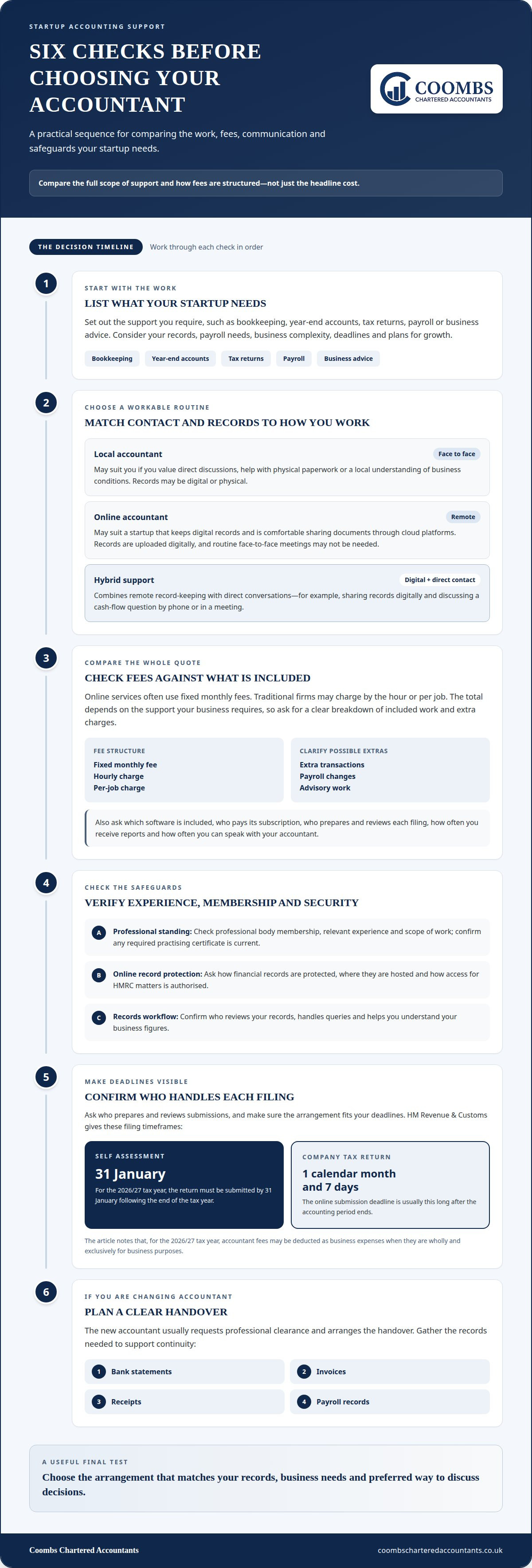
The cheapest-looking option isn’t always the best fit for a startup. Choosing a local accountant vs online support means weighing how fees are structured, what work is included and how much personal contact you need. Online services often use fixed monthly fees, while traditional firms may charge by the hour or per job, so the total depends on the support your business requires.
It’s understandable to focus on cash flow, but the right accountant should also help you stay on top of your records and understand your figures. Remote support can work well if you’re comfortable using cloud software and sharing documents digitally. A local accountant may suit you if you value direct conversations and support grounded in the needs of businesses around Manchester, Stockport, Wilmslow and Alderley Edge.
This guide compares local and online accounting support, including communication, software and the work involved. Use it to decide which arrangement fits your startup now and what to look for as your business develops.
Key Takeaways
- Compare the full scope of support and how fees are structured, not just the headline cost.
- Decide whether face-to-face conversations and local connections matter for the advice your startup needs.
- Consider how comfortable you are sharing records digitally and using cloud software for ongoing support.
- Match your accountant to your business’s complexity, deadlines and plans for growth.
Is online accounting or a traditional accountant better for a UK startup?
The right choice depends on your records, payroll needs, business complexity and preferred way to communicate. Compare the work covered and the support available, not simply whether an accountant works locally or online.
Local accountants for UK small businesses
Local accountants suit business owners who value in-person discussions, help with physical paperwork or knowledge of nearby business conditions. They can review bookkeeping records face to face and discuss decisions such as hiring or cash flow. This approach is particularly useful when a startup’s finances need regular explanation, or its owner prefers handing over documents rather than uploading them.
Online accountants for UK small businesses
Online accountants suit startups that keep digital records and are comfortable sharing documents through cloud platforms. Remote support can cover businesses across the UK, making location less relevant when the work and communication fit. This can be a practical match for a straightforward business that needs bookkeeping, payroll or filing support without routine face-to-face meetings.
Fees, tax deadlines and filing support
For the 2026/27 tax year, accountant fees may be deducted as business expenses when they are wholly and exclusively for business purposes. HM Revenue & Customs says Self Assessment tax returns for that tax year must be submitted by 31 January following the end of the tax year. For a company tax return, the online submission deadline is usually one calendar month and 7 days after the accounting period ends, according to HM Revenue & Customs. Ask for a clear breakdown of included work and extra charges, including bookkeeping, payroll and filing support.
Qualifications, security and switching accountants
Before appointing an accountant, check their professional body membership, relevant experience and scope of work; confirm that any required practising certificate is current. For online support, ask how the provider protects financial records, where they are hosted and how access for HMRC matters is authorised. To switch, the new accountant usually requests professional clearance and arranges a handover; gather bank statements, invoices, receipts and payroll records to support continuity.
| Option | Contact | Records | Best fit |
|---|---|---|---|
| Local accountant | Face to face | Digital or physical | Hands-on discussion |
| Online accountant | Remote | Uploaded digitally | Cloud-based workflows |
Choose the arrangement that matches your records, business needs and preferred way to discuss decisions.
Online accounting services compared with traditional local firms
Accounting services differ in how you communicate, use software and access guidance. Some firms combine cloud tools with personal support, bringing together digital access and direct conversations.
Online accounting services and cloud software
Online accounting uses digital tools to organise transactions and share financial information remotely. Choosing a local accountant vs online support partly depends on whether that workflow suits your routine. Cloud software can bring records together, and local firms may use it too. Ask who reviews your records, handles queries and helps you understand your business figures.
A hybrid approach combines remote record-keeping with direct contact. You might share records digitally, then discuss a cash-flow question by phone or in a meeting. This can suit a business owner who wants cloud access as well as conversations with an accountant, rather than relying only on automated messages or a general support desk.
Service range and quote comparisons
Accounting support can include bookkeeping, year-end accounts, tax returns, payroll and business advice. Compare which tasks are covered, how often you’ll receive reports and who handles submissions. Accounts preparation, for example, is different from ongoing bookkeeping or payroll, so make sure the arrangement matches the work your startup needs.
- Ask which accounting software is included and who pays its subscription.
- Clarify charges for extra transactions, payroll changes or advisory work.
- Confirm who prepares and reviews each filing.
- Establish how often you receive reports and speak with your accountant.
These questions make quote comparisons more useful by showing what each service delivers and where additional charges may apply. If you’d like to discuss how these tasks could fit your business, talk through your accounting needs.
Benefits of face-to-face meetings and local networks
Direct conversations can help when you want to discuss financial details or understand your options. Whether that means meeting in person or talking remotely depends on how you prefer to work.
Face-to-face communication and support
Traditional accountants may offer face-to-face meetings to review accounts, explain figures and discuss options directly. A startup owner deciding between sole trader and limited company structures, for example, can talk through the financial implications with an adviser in person. This differs from remote support, where questions and documents are usually handled digitally. Agreeing a regular meeting rhythm can help make discussions purposeful.
In-person conversations can also make it easier to explain an unusual transaction or bring paper records for review. A local accountant may accept physical documents, while an online service typically relies on digital uploads. For a sole trader preparing for Self Assessment, discussing income and expenses together can clarify which records need attention before filing.
Local presence and business networks
A local firm may understand the business environment around its office and meet clients nearby. One forum participant described a typical local-client catchment as a 15-mile radius, illustrating why location can shape access to in-person support. Local contact may also help business owners become familiar with nearby commercial networks, although introductions depend on the people and relationships involved.
For a startup, local understanding can be useful when decisions involve nearby customers, suppliers or trading conditions. A business owner planning to open premises, for example, may want to discuss expected costs and cash-flow pressures with an accountant. Remote advice can also support financial decisions, so consider whether local context or the convenience of digital contact matters more to you.
Before deciding, identify the conversations you value most: explaining complex structures, reviewing paperwork or discussing growth plans. Then consider how often you would use in-person support. One accountant in a forum discussion said they met each client at least four times a year, a useful example of a regular meeting pattern rather than a requirement. Choose the format that suits your working style and the decisions ahead.
Cloud software and remote accounting support
Cloud software changes how a startup and its accountant share financial data. Most UK accountants work remotely and support clients nationwide, so location may matter less than the working relationship and support required.
With cloud accounting, a business can record transactions and share access with its accountant. Sales invoices, purchase receipts and bank transactions can be organised in one digital system. The accountant can review records remotely and explain what needs attention. This workflow suits owners who can keep digital records up to date and want to access financial information without travelling to a meeting.
Software does not replace an accountant’s professional judgement. An accountant can review entries, explain unusual costs and help you understand reports before making a business decision. Agree who records transactions, checks reconciliations and follows up missing paperwork. Clear responsibilities reduce duplicated work and help keep financial records organised.
Digital processes also connect with UK reporting requirements. HM Revenue & Customs says VAT-registered businesses must comply with Making Tax Digital requirements. As HMRC expands Making Tax Digital, suitable digital record-keeping is increasingly relevant to small businesses. The accountant can help align bookkeeping routines with the business’s reporting needs.
- Agree which records the business uploads and how often.
- Set out who reviews transactions and raises queries.
- Clarify how the accountant will explain reports and advice.
A clear communication plan helps maintain a personal working relationship, even when records are shared remotely. Agree which tasks the accountant handles, which remain with the business and how you’ll discuss changes as the company grows. A startup taking on staff, for example, may need payroll support as well as regular financial reporting.
Cloud tools work best when they support regular communication, not just document storage. To discuss an approach that fits your records and working preferences, Contact Us.
Coombs Chartered Accountants
Coombs Chartered Accountants helps startups in Manchester, Stockport, Wilmslow and Alderley Edge find accounting support suited to their records, reporting needs and plans. If you want remote access alongside professional guidance, Cloud Accounting can support digital record-keeping, while Statutory Accounts Preparation and Tax Compliance address key reporting responsibilities.
As your business develops, Tax Planning can help you consider the financial implications of decisions such as changing your structure or investing in growth. The right support depends on the work you need and how you prefer to communicate, whether remotely or through direct conversations.
If you’re weighing up your options, contact Coombs Chartered Accountants to discuss the accounting support that fits your business.
Choose support that can grow with your business
Choosing a local accountant versus online support isn’t a decision you need to make once and leave unchanged. As your startup develops, the work you need from an accountant may shift. Review your needs when priorities change, such as taking on staff, entering a new market or planning an investment.
Before speaking with an accountant, note the decisions you want help with, the tasks you expect them to handle and how you prefer to communicate. This gives you a clear starting point for agreeing responsibilities and suitable support. It also helps connect accounting work with your plans, rather than focusing only on routine filings.
Coombs Chartered Accountants can discuss your circumstances and help you consider the right accounting support for your next stage. Take the next step when you’re ready: Contact Us.
Frequently Asked Questions
What are the advantages and disadvantages of an online accountant?
Online accounting can make it easier to share documents and review figures without travelling to a meeting. This can suit a business owner who keeps digital records and prefers remote communication. You’ll need reliable access to your records and confidence using the platform. Before engaging, agree how to raise time-sensitive questions and who will explain unfamiliar figures.
Which model is more responsive and proactive?
Responsiveness depends on the communication arrangements, not simply the accountant’s location. Regular reviews can help you discuss issues before deadlines, whether remotely or face to face. Ask how queries are handled, how progress is reported and who you’ll speak with. A clear contact route helps prevent unanswered questions becoming last-minute filing problems.
What do local accountants and online accountants typically charge in the UK?
There is no single fee that applies to every UK startup, because the work and business circumstances differ. The price depends on the case and is given after a quote request; key factors include business structure, transaction volume, payroll requirements and the filings needed. Compare quotes on matching tasks and reporting periods, so a different service scope doesn’t make one option appear cheaper.
What services are included in local versus online accountancy fees?
Work covered varies by engagement, so compare deliverables rather than relying on labels such as “local” or “online”. An arrangement may include year-end accounts and tax returns, while bookkeeping, payroll or management reporting may be separate. If your startup employs staff, clarify whether payroll processing and related reporting are included. Also establish how additional advice or corrections will be handled.
How do local and online accountants compare for response times and personal support?
Response times depend on the agreed contact arrangements, not simply the accountant’s location. Face-to-face meetings offer direct discussion, while remote support may use email, telephone or a client platform. Before appointing an accountant, agree the usual channel for routine questions, how complex matters are escalated and whether you’ll speak with the same person. Recording those expectations helps make personal support more consistent.


