

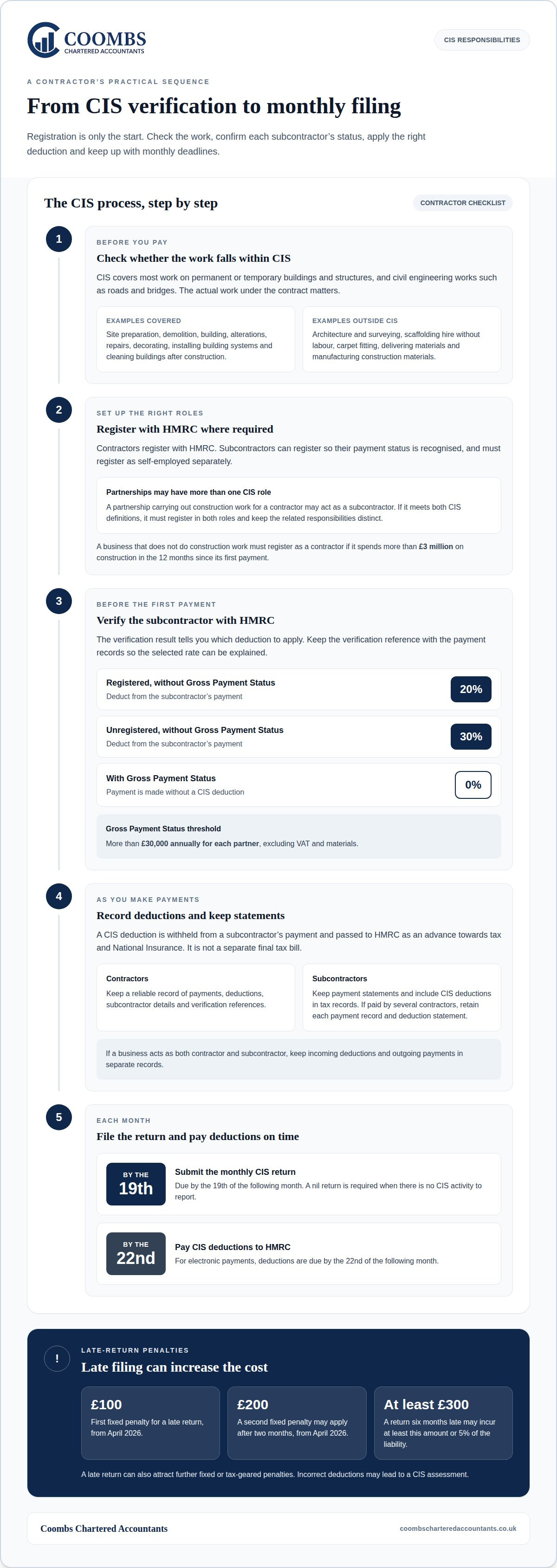
Registration is the start of the process, not the finish: contractors must verify a subcontractor with HMRC before the first payment, then apply the correct deduction. The rate is 20% for a registered subcontractor without gross payment status, 30% for an unregistered subcontractor, and 0% for a subcontractor with gross payment status. CIS registration help for contractors can clarify how these rules apply to your business, including if you operate as a partnership.
It’s understandable to focus on getting registered, but what happens next matters just as much. Contractors must manage deductions and ongoing CIS responsibilities, while partnerships need to consider how their structure affects registration and Gross Payment Status.
This guide explains who needs to register, what to expect afterwards and how deduction rates work. It also covers how professional accounting support can help you organise CIS responsibilities and meet the requirements that apply to your business.
Key Takeaways
- Understand what happens after registration, including the records and monthly return responsibilities contractors need to manage.
- Learn when a construction partnership may need to register in more than one CIS role.
- See how the rules can apply to businesses that do not carry out construction work themselves.
- Recognise when accounting support can help clarify CIS responsibilities and keep tax compliance on track.
CIS deduction rates for registered and unregistered subcontractors
A subcontractor’s CIS payments depend on registration and Gross Payment Status. Contractors use this information to apply the correct deduction and keep clear records.
Deductions and tax and National Insurance
A CIS deduction is money withheld from a subcontractor’s payment and passed to HMRC as an advance towards tax and National Insurance. This affects the funds available for labour, materials and other business commitments. For example, a subcontractor paid by several contractors should keep each payment record and deduction statement. These records link CIS deductions to the subcontractor’s tax position, rather than treating each deduction as a separate final tax bill.
Gross Payment Status and deductions
Gross Payment Status means a subcontractor receives payment without a CIS deduction. HMRC states the threshold is more than £30,000 annually for each partner, excluding VAT and materials. HMRC states that the gross payment status turnover threshold is more than £30,000 annually for each partner, excluding VAT and materials. Without Gross Payment Status, the usual deduction is 20% for a registered subcontractor; HMRC says contractors must withhold 30% from payments to CIS-unregistered subcontractors without that status. The status therefore affects cash received from each contract.
Contractor verification and deductions
Contractors verify a subcontractor’s status with HMRC before making the first payment. The verification result guides the deduction: 20% for a registered subcontractor without Gross Payment Status, 30% for an unregistered subcontractor without it, or 0% for a subcontractor with Gross Payment Status. Keeping the verification reference with payment records helps explain how the correct rate was chosen. HMRC sets the monthly deadline for a CIS return, including a nil return, as the 19th of the following month. From April 2026, HMRC sets the first fixed penalty for a late return at £100.
When contractors and subcontractors may need professional help
Professional advice can help when CIS roles, worker arrangements or payment records are difficult to distinguish. First identify the issue that needs resolving, before it affects a return or a subcontractor’s tax records.
CIS registration for contractors and subcontractors
Contractors register with HMRC, while subcontractors can register so their payment status is recognised. A subcontractor must also register as self-employed separately. Advice can help when a business starts paying subcontractors, begins taking construction contracts itself or operates in both roles. These changes can affect record-keeping and reporting processes. If an individual works through an agency or umbrella company, clarify the contractual arrangement and who handles tax obligations before treating the work as self-employment.
Contractor and subcontractor obligations
Contractors need a reliable process for recording payments, deductions and subcontractor details. Subcontractors should keep payment statements and include CIS deductions in their tax records. If a business acts as both contractor and subcontractor, keep separate records for incoming deductions and outgoing payments. This helps prevent the responsibilities from becoming mixed when preparing accounts or returns. Advice can be particularly useful when records do not clearly identify which role a payment relates to.
For electronic payments, CIS deductions are due to HMRC by the 22nd of the following month. The monthly return, including a nil return, is due by the 19th of the following month, according to HMRC. A late return can attract further fixed or tax-geared penalties, while incorrect deductions may lead to a CIS assessment. From April 2026, a second fixed penalty of £200 may apply after two months; a return six months late may incur at least £300 or 5% of the liability.
Where employment status, records or return preparation overlap, discuss your CIS position with an accountant.
CIS registration for construction partnerships
A partnership’s CIS position depends on the work it undertakes and the payments it makes. It may have contractor responsibilities, subcontractor responsibilities or both, so assess each activity separately.
The Construction Industry Scheme is set within the framework of the Finance Act 2004. HMRC states that a business that does not do construction work must register as a contractor if it spends more than £3 million on construction in the 12 months since its first payment. This rule can affect organisations outside the construction industry that commission building projects. The relevant issue is the business’s construction spending and payment history, not simply whether construction is its main trade.
CIS covers most work on permanent or temporary buildings and structures, as well as civil engineering works such as roads and bridges. Covered activities can include site preparation, demolition, building, alterations, repairs, decorating, installing building systems and cleaning buildings after construction. These examples help partnerships distinguish construction operations from services that merely support a project. The actual work under the contract matters: a business name or broad description alone may not show which activities are covered.
Some activities are outside CIS, including architecture and surveying, scaffolding hire without labour, carpet fitting, delivering materials and manufacturing construction materials. If a partnership’s contracts combine covered and excluded activities, identify what it is paying for and who performs each task. This can help establish whether a payment relates to construction work and whether contractor responsibilities apply.
A partnership can also act as a subcontractor when it carries out construction work for a contractor. If it meets both CIS definitions, it must register in both roles and keep the related responsibilities distinct. This is especially relevant when partners undertake site work while the partnership hires other trades. Businesses based outside the UK are also subject to CIS when working as contractors or subcontractors on UK construction projects.
Contractor registration with HMRC
Contractors must register with HMRC before paying subcontractors for construction work. The registration route depends on the business structure, and registration is not automatic.
HMRC registration process
Sole traders, limited companies and partnerships must first register as employers, then register online for CIS as contractors. A contractor can seek help with the registration process by phone. This order matters because HMRC treats contractor registration as part of setting up as a new employer.
After registration, HMRC sends a letter with information needed to operate as a CIS contractor, including the employer PAYE reference. Keep this reference with your CIS records and use it when dealing with HMRC. Registration establishes the contractor’s reporting responsibilities, but does not automatically settle subcontractor status or deductions.
To amend or cancel a CIS registration, contact HMRC and explain which business details have changed or that contractor activity has stopped. The CIS Helpline is 0300 200 3210; having the business details and PAYE reference available can help HMRC identify the registration.
Registration support
HMRC provides CIS webinars, emails and videos about registration and scheme responsibilities. Contractors needing help with registration can call the New Employer Helpline, while the CIS Helpline handles CIS queries. Choose the support route that matches the issue, such as employer setup or CIS reporting.
After registering, contractors must keep up with monthly returns, including a nil return when no subcontractors were paid, unless they have arranged an eligible period of inactivity with HMRC. CIS deductions are paid to HMRC, so accurate payment records support reporting and tax assessment.
Where employer setup, CIS registration and ongoing returns need coordinating, Contact Us to discuss CIS support.
Coombs Chartered Accountants
Coombs Chartered Accountants helps construction businesses understand their CIS responsibilities and organise tax reporting. If you’re unsure how contractor registration fits your business structure, or need support managing deductions and returns, tailored Construction Industry Scheme support can clarify the practical steps.
Good CIS records also support wider tax compliance. Coombs can help with tax compliance, tax planning and cloud accounting, so you can manage financial information alongside scheme obligations. Statutory accounts preparation can also present your business’s financial position clearly.
For support that reflects your business and the way it works, contact Coombs Chartered Accountants to discuss your CIS requirements.
Put your next CIS decision on a clear footing
Make sure your CIS arrangements reflect how your business operates. Changes to contracts, partnership roles or subcontracting activity can affect how your responsibilities connect with your wider accounts and tax position. Reviewing these together can help you plan ahead instead of treating each return as an isolated task.
Coombs Chartered Accountants supports businesses with CIS requirements and related tax work, including Tax Compliance, Tax Planning and Statutory Accounts Preparation. If you need CIS registration help for contractors, we can help you understand how scheme responsibilities relate to your business records. Practical CIS registration help for contractors can bring registration questions and wider tax considerations into the same conversation.
Talk to Coombs Chartered Accountants about your circumstances and possible next steps. Contact Us to move forward with a clearer plan for your construction business.
Frequently Asked Questions
What Happens After Registration?
After registration, HMRC sends a letter with information for operating as a contractor, including an employer PAYE reference. Keep it with the business’s CIS records so it is available for scheme administration. Before making a first payment to a subcontractor, the contractor verifies their payment status. For example, record the verification outcome alongside the subcontractor’s details and payment records to support accurate reporting.
Why Is CIS Registration Important for Partnerships?
Registration helps a partnership meet the CIS responsibilities that match its activities. It may pay subcontractors for construction work and also undertake work as a subcontractor itself. If it meets both definitions, it must register in both roles. Keep incoming deductions and outgoing contractor payments in separate records to avoid confusing reporting for one role with the other.
What is covered by CIS?
CIS covers most construction work on permanent or temporary buildings and structures, as well as civil engineering work such as roads and bridges. The activity matters: installing building systems and demolition can fall within the scheme, while architecture and surveying are excluded. A mixed contract may involve different types of work, so classify the actual services provided.
Who is a contractor under CIS?
A business is a contractor under CIS if it pays subcontractors to carry out construction work. A business outside the construction industry can also fall within the rules if its construction spending meets HMRC’s threshold. The practical question is whether the business commissions construction work and pays others to do it. This can include arranging building work for premises used in its operations.
Will I be employed or self-employed?
CIS registration does not make a worker self-employed. Employment status is assessed separately for each contract, so someone may be self-employed under one arrangement and employed under another. The terms and working arrangements matter. This distinction is particularly relevant when work is arranged through an agency, umbrella company or partnership, as the business relationship can affect who handles tax responsibilities.
What is the Construction Industry Scheme (CIS) and who needs to register?
The Construction Industry Scheme sets rules for contractors paying subcontractors for construction work. Contractors must register with HMRC, while subcontractors are not required to register, although registration affects the deduction applied to their payments. A business acting as both contractor and subcontractor must register in both capacities. This distinction helps identify which scheme obligations apply to each payment and working relationship.


